
In today’s global supply chains, good intentions are no longer enough.
Brands are expected to prove where their materials come from—especially when it comes to natural resources like wood.
For industries that rely on biomass—such as garment manufacturing—the challenge is real.
Factories often source wood for steam generation, but identifying whether that wood comes from approved, sustainable residues or from deforestation-linked sources is difficult, time-consuming, and costly. Traditional verification methods require experts, lab testing, or paperwork that isn’t always reliable.
This is exactly where WoodAI steps in.
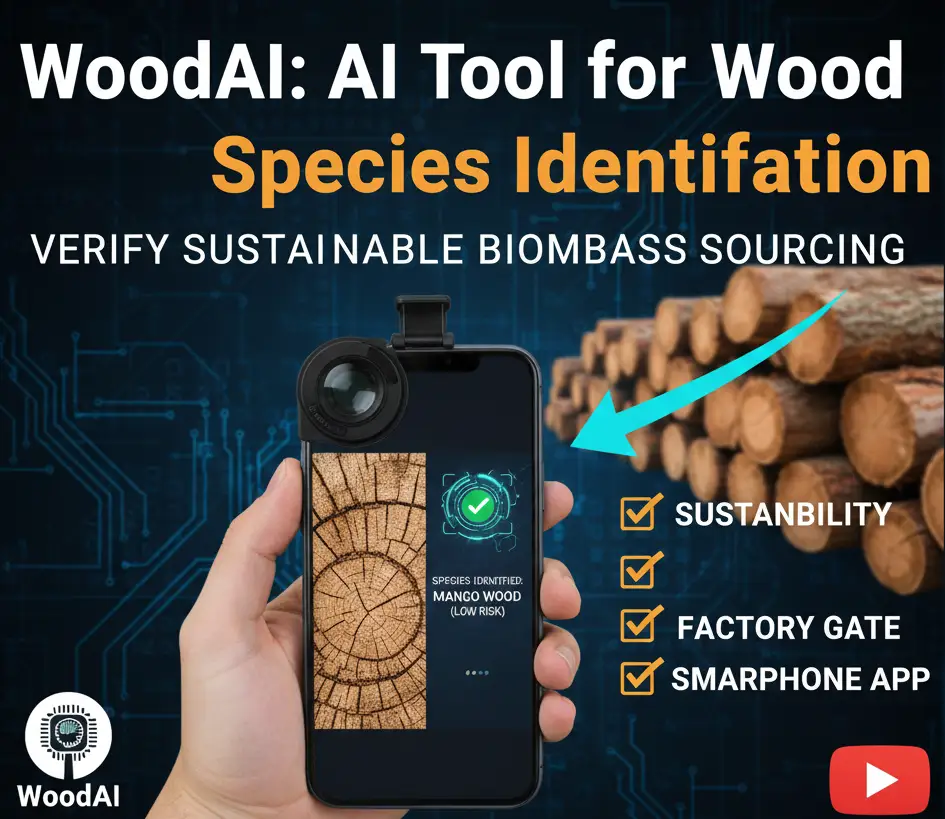
WoodAI uses artificial intelligence to identify wood species instantly using a smartphone, helping factories verify their biomass sourcing at the factory gate itself.
It’s not flashy tech for the sake of innovation.
It’s purpose-driven AI built to solve a real-world sustainability problem.
WoodAI is an AI-powered mobile application that identifies wood species using smartphone images and a macro lens. It helps garment factories and manufacturers verify sustainable biomass sourcing, reducing deforestation risks and improving supply chain transparency.
What Is WoodAI?
WoodAI is an artificial intelligence-based wood species identification app designed to help organizations verify the origin of wood used in industrial processes—particularly for biomass and steam generation.
Instead of relying on documentation or supplier claims, WoodAI allows factories to visually verify wood species on-site, using nothing more than:
- A smartphone
- A macro lens
- The WoodAI app
By analyzing microscopic patterns in wood structure, the app determines whether the wood belongs to approved plantation species or potentially high-risk sources.
This makes WoodAI especially valuable for industries under pressure to meet sustainability, traceability, and deforestation-free sourcing commitments.
Why Wood Species Identification Matters in the Garment Industry
The garment industry consumes massive amounts of energy, much of it generated using biomass fuel such as wood residues.
The problem?
Not all wood is equal.
Some sources:
- Come from plantation residues (low risk)
- Are byproducts like mango or cashew wood (approved)
- Others may come from illegal logging or deforestation-prone areas
Without proper verification, factories may unknowingly contribute to deforestation—putting both brands and ecosystems at risk.
WoodAI addresses this gap by turning sustainability checks into a simple, fast, and scalable process.
How WoodAI Works
WoodAI’s workflow is intentionally simple:
- Capture an image of the wood sample using a smartphone with a macro lens
- Upload the image through the WoodAI app
- AI analyzes wood anatomy patterns
- Species classification is generated
- Factory can verify whether the wood matches approved sourcing guidelines
No lab tests.
No waiting days for results.
No specialist training required.
This is AI designed for real factory conditions, not research labs.
Core Features of WoodAI
1. AI-Based Wood Species Identification
WoodAI uses machine learning models trained on wood anatomy patterns to recognize species accurately.
This allows:
- Fast identification
- Reduced human error
- Standardized verification across locations
2. Smartphone-First Design
No expensive hardware required.
All identification happens using:
- A standard smartphone
- A simple macro lens attachment
This makes WoodAI highly scalable for factories in developing regions.
3. On-Site Verification at Factory Gate
Instead of trusting supplier paperwork, factories can:
- Verify wood before it enters the facility
- Reduce compliance risks
- Improve internal audits
4. Sustainability & Compliance Support
WoodAI supports responsible sourcing goals by:
- Helping identify plantation species like mango and cashew
- Reducing deforestation-linked biomass usage
- Supporting brand sustainability commitments
5. Designed for Industrial Use
This isn’t a consumer curiosity app.
WoodAI is built for:
- Manufacturing environments
- Supply chain audits
- Corporate sustainability programs
Use Case: WoodAI in the Garment Industry
The most prominent use case for WoodAI is within garment manufacturing, where factories rely on wood-based biomass for steam generation.
By using WoodAI:
- Factories verify approved biomass sources
- Brands gain confidence in supplier compliance
- Sustainability teams reduce audit complexity
Notably, WoodAI is currently being pilot-tested by H&M Group, demonstrating real-world enterprise adoption—not just theory.
Why WoodAI Is Different from Traditional Methods
Traditional wood verification methods include:
- Manual inspection by experts
- Laboratory analysis
- Documentation checks
These methods are:
- Expensive
- Slow
- Not scalable
- Often inaccessible in factory environments
WoodAI changes the equation.
Key Differentiators
- Instant results
- Low-cost setup
- Field-ready deployment
- AI-powered accuracy
- Digital traceability potential
It replaces uncertainty with data-driven confidence.
Pros and Cons of WoodAI
| Pros | Cons |
|---|---|
| AI-powered wood identification | Currently limited availability |
| Smartphone-based, low hardware cost | Requires macro lens attachment |
| Supports sustainable sourcing | Still in pilot testing phase |
| Reduces deforestation risk | Not a consumer-facing app |
| Ideal for factory environments | Accuracy depends on image quality |
Who Should Use WoodAI?
WoodAI is ideal for:
- Garment Factories – Factories using biomass fuel for steam production can verify wood sourcing on-site.
- Global Fashion Brands – Brands with sustainability commitments gain better supplier transparency.
- Sustainability & Compliance Teams – Helps meet ESG, deforestation-free, and responsible sourcing goals.
- NGOs & Environmental Organizations – Supports data-driven forest conservation efforts.
- Supply Chain Auditors – Adds an extra layer of verification beyond paperwork.
Pricing and Access Model
WoodAI is currently in pilot testing, with early access available through:
- Partner brands
- Sustainability organizations
- Industry stakeholders
Rather than mass-market pricing, WoodAI follows a controlled rollout model, ensuring:
- Accuracy improvements
- Real-world validation
- Responsible deployment
For early access, interested organizations are encouraged to connect via sustainability partners such as H&M Group or WWF representatives in supported regions.
The Bigger Picture: Why WoodAI Matters
WoodAI isn’t just a tool—it represents a shift.
A shift from:
- Trust-based sourcing → Verified sourcing
- Paper audits → On-site AI verification
- Sustainability claims → Evidence-backed action
As regulations tighten and consumers demand transparency, tools like WoodAI will become essential—not optional.
Final Verdict: Is WoodAI Worth Attention?
Absolutely.
WoodAI solves a real sustainability problem using practical AI—not hype.
It doesn’t try to replace humans.
It empowers factories, brands, and auditors with instant, reliable insights.
If your organization cares about:
- Responsible biomass sourcing
- Deforestation risk reduction
- Scalable sustainability solutions
Then WoodAI is a technology worth watching—and adopting early.
Frequently Asked Questions (FAQs)
1. What is WoodAI used for?
WoodAI is used to identify wood species using AI, helping verify sustainable biomass sourcing in industrial environments.
2. Does WoodAI require special equipment?
Only a smartphone and a macro lens are needed—no lab equipment required.
3. Is WoodAI available to the public?
Currently, WoodAI is in pilot testing and available through select sustainability partners.
4. Which industries benefit most from WoodAI?
Garment manufacturing, textiles, and any industry using biomass fuel benefit the most.
5. How accurate is WoodAI?
Accuracy depends on image quality and training data, but the AI is designed for practical, real-world identification.
Conclusion & Call to Action
Sustainability can’t rely on assumptions anymore.
It needs verification, accountability, and technology that works where it matters most—on the ground.
WoodAI brings artificial intelligence out of the lab and into the factory gate, helping industries move from intention to action.
If you’re serious about responsible sourcing, WoodAI is the future you should be preparing for—today.
Sustainability isn’t just about doing better. It’s about proving it.